
Indian Arrowheads of the Piedmont
What these ancient artifacts reveal about North Carolina's earliest inhabitants.
By Ron Harris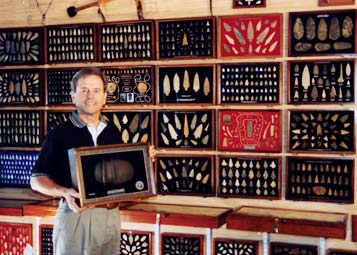
Ron Harris holds a prized Southern trophy stone axe head found in 1940 by a friend of his father’s, who later donated it to the Harris collection. The axe was found at Lyle Creek, near Conover in Catawba County. Considered one of the finest ever found in the state, the axe has been featured in several archaeological publications. Harris is shown in his “relic room” with Indian arrowheads and artifacts found in the Piedmont region.
Reminders of North Carolina's earliest inhabitants appear in the form of Indian arrowheads that were once plentiful in central North Carolina. These Carolina gems have been found in almost every area of North Carolina, especially in the central Piedmont region. There are numerous collectors throughout that area who have hunted, traded, bought and otherwise accumulated collections of various sizes over the past decades.
The earliest inhabitants of what is now North Carolina were the Paleo Indians of the Clovis Culture, who made beautifully flaked stone Clovis points (read about a North Carolina museum highlighting Native American culture). Fluted channels on the points aided in "hafting" or attaching them to a spear shaft. Clovis points date back 10,000 to 12,000 years ago and are infrequently found at various locations throughout North Carolina as well as other areas the United States. Clovis points are highly prized by collectors and are displayed with pride, considering their rarity.
Later cultures, like the Hardaway people, inhabited various areas of the Piedmont region in slightly greater numbers than did the Clovis. The Hardaway technology in the making of flint-tipped spears or "atlatl" darts changed to what is called the Hardaway-Dalton, and Hardaway side-notched style points. The Hardaway culture existed in what archaeologists term the early archaic period or about 10,000 to 11,000 years ago. Later prehistoric cultures or traditions to evolve in North Carolina included Palmer, Kirk, Rowan, Stanly, Morrow Mountain, Guilford, Halifax and Savannah River. These cultures existed through the early, mid and late archaic periods with a time span of 3,000 to 10,000 years ago. Spear points and flint knives from these traditions are found on knolls or ridges near streams and natural springs where these cultures camped while in search of fruit, nuts and wild game for food. These earliest inhabitants of North Carolina were considered "hunters and gatherers."
The bow and arrow wasn't introduced into use in North Carolina until sometime in the millennium after the birth of Christ. This was the Woodland period that dates from 3,000 years ago until around AD 1400. Projectile points during this period were small and triangular-shaped. These flint points were actually the first "true" arrowheads. They are found on Woodland period sites close to major rivers, streams and water sources. By this time, the Woodland people were more settled in their way of life and engaged in the planting, growing and harvesting of crops in the rich fertile river bottoms along major Piedmont waterways and their tributaries. Arrowheads from this period are called Yadkin, Eared Yadkin, Pee Dee, and Uwharrie. These are all named after major rivers in the area near where they are found.
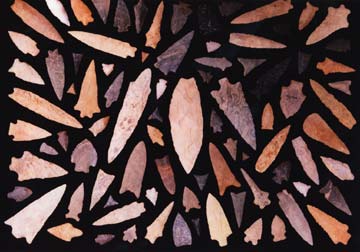 These arrowheads in the Harris collection were found during many years of surface hunting in fields of the Piedmont region where Indians lived hundreds and, in some cases, thousands of years ago.
European contact with the indigenous Native Americans began in the early 1600s and into the 1700s. This period of time is called the Historic period. Arrowheads used by the Native Americans during this period are called Caraway, Randolph and Hillsboro types.
The projectile points and cutting blades made and used by the ancient natives were essential for their survival and existence at that point in our prehistory. Today, however, many consider these flint points or artifacts as gems and even objects of ancient art. They are highly prized, treasured and collected by both old and young alike.
In the past, archaeologists excavated stratified (layered) sites where prehistoric people once camped or existed. They were able to establish a chronological sequence of the various ancient cultures and their associated projectile points by the carbon dating process. That is how we are able to differentiate between the various point types found today in plowed fields, gullies, washouts, riverbanks, construction sites, and elsewhere. Credit for establishing this culture sequence is given to the late Dr. Joffre Coe of the University of North Carolina at Chapel Hill. In the 1940s and 1950s, he completed scientific surveys and excavations of stratified sites at Hardaway, Doershuck and Gaston among others.
Interest in Indian prehistory and the collecting of their arrowheads was so great that the Piedmont Archaeology Society of North and South Carolina was formed several decades ago and is still going strong. It is composed of individuals, enthusiasts, hobbyists, amateur archaeologists, educators and collectors who are genuinely interested in learning from and preserving the remnants of prehistoric life in North Carolina.
The Piedmont Society holds at least three or four relic shows each year at various locations in North and South Carolina. Admission is free and hundreds of member collectors and the general public as well attend to swap stories, display their artifacts, buy, sell, trade and generally exchange archaeological research information and updates.
About the Author
Ron Harris is a member of EnergyUnited, a Touchstone Energy cooperative. He lives on Lake Hickory in the Bethlehem community of Alexander County. Contact him at P. O. Box 1516, Hickory, NC 28603. E-mail: harrisheadhunter@aol.com-
More about Native Americans in North Carolina
-
Share this story:



Comments (149)
Annette |
December 28, 2012 |
reply
Thanks,
-Carlos
Carlos |
October 29, 2019 |
reply
Sonia Neville |
June 11, 2014 |
reply
Jessica |
October 07, 2014 |
reply
Carlos |
October 18, 2019 |
reply
Justin |
April 06, 2021 |
reply
I may be interested in some of the artifacts you have for sell. If you could e-mail me some pictures and prices of what you have.
Thanks!
Shelton
Shelton |
October 08, 2014 |
reply
Susan s. |
December 23, 2021 |
reply
For some reason it will not let me reply to you via email. My personal email is Jessicaegebrecht@gmail.com. Sent me a private email and I will send you photos.
Jessica |
October 09, 2014 |
reply
Bob Kinney |
October 14, 2014 |
reply
Troydewaynewilliams@yahoo.com
Troy |
December 31, 2014 |
reply
John Hill, Sr |
September 05, 2021 |
reply
Susan s. |
December 23, 2021 |
reply
Joseph |
December 24, 2021 |
reply
Joseph |
December 24, 2021 |
reply
Tom Maddox |
December 24, 2021 |
reply
Donald Ballance |
February 13, 2023 |
reply
amanda mullins |
February 05, 2015 |
reply
John Hill, Sr |
September 05, 2021 |
reply
I would love to see the arrowheads and spears that you have. My e-mail address is: srd0323@embarqmail.com.
Thanks!
Shelton
Shelton |
February 05, 2015 |
reply
Levi |
March 06, 2015 |
reply
Nick |
March 08, 2015 |
reply
Cramer Kilpatrick |
March 25, 2015 |
reply
sonia neville |
March 26, 2015 |
reply
Cramer Kilpatrick |
March 27, 2015 |
reply
Regards,
Sonia
sonia neville |
March 29, 2015 |
reply
TommyQueen |
March 30, 2015 |
reply
Donald Ballance |
February 13, 2023 |
reply
Cramer Kilpatrick |
March 31, 2015 |
reply
Chuck |
April 19, 2015 |
reply
Donald Ballance |
February 13, 2023 |
reply
Eddie Hendrix |
May 20, 2015 |
reply
Ron |
July 17, 2015 |
reply
Ron |
July 17, 2015 |
reply
Ron |
July 17, 2015 |
reply
Ron |
July 17, 2015 |
reply
Cramer Kilpatrick |
July 21, 2015 |
reply
Darin Smith |
July 24, 2015 |
reply
Regards,
Sonia Neville
SONIA NEVILLE |
July 24, 2015 |
reply
Tommy Queen |
July 25, 2015 |
reply
Tommy Queen |
July 25, 2015 |
reply
jordan |
August 28, 2015 |
reply
North Carolina Arrowheads & Artifacts
http://on.fb.me/1iypIt2
Ashley |
September 11, 2015 |
reply
James |
November 07, 2015 |
reply
Sonia |
November 07, 2015 |
reply
elijah |
November 13, 2015 |
reply
Don |
November 28, 2015 |
reply
Mike Russ |
January 18, 2016 |
reply
Kenneth |
April 06, 2016 |
reply
Sheila |
May 09, 2016 |
reply
Malissa Byerly |
May 17, 2016 |
reply
Frank Alexander |
May 17, 2016 |
reply
Kameron |
July 09, 2016 |
reply
Jason |
November 20, 2016 |
reply
Charles parrish |
November 25, 2016 |
reply
Charles parrish |
November 25, 2016 |
reply
Charles parrish |
November 25, 2016 |
reply
Pete Lozica |
December 10, 2016 |
reply
Charles parrish |
December 14, 2016 |
reply
Pete Lozica |
December 16, 2016 |
reply
terry |
December 18, 2016 |
reply
Frank Alexander |
December 19, 2016 |
reply
Kathy Fuller |
December 11, 2021 |
reply
Dicky Green |
December 27, 2021 |
reply
B Bailey |
January 22, 2022 |
reply
Pete Lozica |
December 19, 2016 |
reply
vince petti |
December 22, 2016 |
reply
Todd |
February 12, 2017 |
reply
Frank Alexander |
February 13, 2017 |
reply
Andy |
February 25, 2017 |
reply
rich carstens |
April 25, 2017 |
reply
David Mauldin |
June 05, 2017 |
reply
Jimmy Williams |
June 12, 2017 |
reply
wayne wallace |
September 19, 2017 |
reply
james |
October 05, 2017 |
reply
Jerimiah |
March 08, 2018 |
reply
Mindy |
March 10, 2018 |
reply
Sunnie |
May 19, 2018 |
reply
Frank Alexander |
May 20, 2018 |
reply
Mindy |
May 20, 2018 |
reply
Frank Alexander |
May 20, 2018 |
reply
james |
May 20, 2018 |
reply
Pete Standfield |
January 21, 2019 |
reply
Bobby Forrester |
April 21, 2019 |
reply
Frank Alexander |
April 22, 2019 |
reply
john grimes |
April 23, 2019 |
reply
Frank Alexander |
April 23, 2019 |
reply
Contact me at vanstunnels45@gmail.com I want to hear more about your site and finds.
Carlos
CARL L VANHOUTEN |
September 21, 2020 |
reply
Just wondering is someone could advise me on a find ?? Stone axe head. Real or not
Thanks Robin
Robin Gagne |
May 17, 2019 |
reply
Frank Alexander |
May 17, 2019 |
reply
Amanda Fender |
June 17, 2019 |
reply
David Mitchell |
August 04, 2019 |
reply
Amanda Fender |
August 13, 2019 |
reply
Michael McElveen |
September 19, 2019 |
reply
Justin Winn |
January 07, 2020 |
reply
Thomas perrigan |
January 18, 2020 |
reply
Tom Maddox |
January 23, 2020 |
reply
Andrew |
June 24, 2020 |
reply
Lisa Baylous Riddle |
June 28, 2020 |
reply
Mary Warren |
July 24, 2020 |
reply
Justin |
April 06, 2021 |
reply
Cyndi Smith |
September 20, 2020 |
reply
-Carlos
CARL L VANHOUTEN |
September 21, 2020 |
reply
CARL L VANHOUTEN |
September 21, 2020 |
reply
Interest in helping me discover more info about it. Regards
Jim Renegar |
January 04, 2021 |
reply
D. Vestal |
April 05, 2021 |
reply
Andy |
April 07, 2021 |
reply
Can you help me identify this find or share a link to someone with experience with tools?
Thank you
Saundra W. Barnhill |
June 18, 2021 |
reply
John C. Lefler |
June 25, 2021 |
reply
Please send a photo to my email and I will try to help you.
Thanks,
-Carlos
Carlos |
June 21, 2021 |
reply
Amber |
June 23, 2021 |
reply
Diana |
July 03, 2021 |
reply
Will Patton |
July 07, 2021 |
reply
SINCE the Central Piedmont is located in a frequently traveled Native American trading route, there is quite a diversity in ages and in the original sites of their origin. We have a site in Cabarrus County, and according to carbon dating of the stones themselves, and combined with their specific designs, they range over a period of 10,000 years.
Hope this helps.
John C.H. Lefler
John C. Lefler |
July 08, 2021 |
reply
Thank you,
Brittany
Brittany |
August 04, 2021 |
reply
Rebecca bonner |
August 07, 2021 |
reply
Rebecca bonner |
August 07, 2021 |
reply
Jesse miller |
August 17, 2021 |
reply
Joe livesay |
October 18, 2021 |
reply
Dicky Green |
January 25, 2022 |
reply
Joe livesay |
February 03, 2022 |
reply
Dicky Green |
February 07, 2022 |
reply
Dicky Green |
February 08, 2022 |
reply
Brad S |
October 18, 2021 |
reply
Dicky Green |
November 13, 2021 |
reply
Brad |
November 20, 2021 |
reply
Dicky Green |
February 08, 2022 |
reply
I recently found my first arrow head so now I am really wanting to find more.
I live east of Raleigh, NC near Clayton and spend a lot of time near Fayetteville.
Does anyone know any good places I could look for arrow heads around or near Clayton and Fayetteville NC?
Thanks!
Cindy |
January 14, 2022 |
reply
B Bailey |
January 22, 2022 |
reply
Jesse Garcia |
May 13, 2022 |
reply
Pop Pop Lampl |
September 09, 2022 |
reply
Zach |
May 30, 2022 |
reply
April |
July 13, 2022 |
reply
Now I am retired living in Pinehurst NC. enjoying my grandkids! I have attended many lectures on local cultures, tools and travel patterns of the indigenous tribes that inhabited North and South Carolina. I have dredged gold here in NC, as well as Northern Ca, Pennsylvania and NY State.
I am also familiar with calcine bone and associated items. We have the oldest documented burials on the Mid -Atlantic seaboard. That was also a contact site with historical features so I can identify historical items from the Dutch settlement times (1600’s ) , through current times. So if it’s stone, bone, minerals, historic things or even fossils , I may be able to help you with some ID !!!
( And I would enjoy the time… )
Reach out anytime,
TY,
Pop Pop L.
Pop Pop Lampl |
September 09, 2022 |
reply
Dicky Green |
September 15, 2022 |
reply
. I have been an avid collector for roughly 20 years, and have an Extremely large collection ranging from small arrow heads to 2ft Spear tips, and Large effigies. Some of the points that we have are over 2 ft long and some up to 4 ft that seem to be something possibly used with a trip wire/ rope kind of trap. They are in Excellent to Museum grade quality. We have been talking about possibly selling some of the items but have no idea where to start as we have SO many beautiful and Rare pieces. We Would be interested in possibly speaking with you and sending you some pics to see what you think about the time frame of these pieces. Thank you look forward to hearing from you soon. You can reach me at beetlejuice.jh@gmail.com
John |
September 25, 2022 |
reply
Just take some good photos. If you wanted a coa, we could talk about that later.
Thank you,
PPL
Ppl |
September 16, 2022 |
reply
Thanks,
Nora
Nora Ketchie |
September 25, 2022 |
reply
Nora Ketchie |
September 25, 2022 |
reply
Lamp’l |
April 29, 2023 |
reply
Is there anyone who can help identify it for me? /It's very beautiful
Marcie Snipes |
September 19, 2022 |
reply
Ppl |
October 10, 2022 |
reply
Emily Deans |
April 18, 2023 |
reply
Thanks!
Jamie |
November 18, 2022 |
reply
Kale |
November 18, 2022 |
reply
Thanks
HJL
Ppl |
November 18, 2022 |
reply
I am surprised at how difficult it has been to find out how prevalent these points are. I know that culture was spread out over the Southeast, but I would love to be able to find out just how common (or uncommon) this style point is.
If you are interested in seeing a photo, I would be glad to send it to you. Please email me at dphuey@comporium.net. Thank you.
Diane |
February 06, 2023 |
reply
Lamp’l |
April 29, 2023 |
reply
Leslie Corley |
September 13, 2023 |
reply