


Hard work
Lee Francis of Ashe County, a lifelong member of Blue Ridge Electric, saw his electric co-op’s crews out working one day and decided to make a painting “to honor their hard work.”
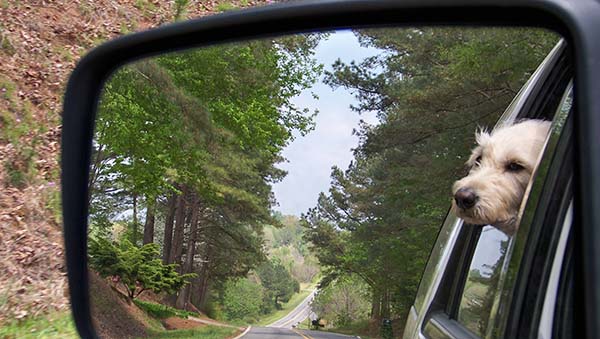
My dog, Marnie, enjoying a recent drive in North Carolina. You can see more at flickr.com/photos/biblepostcards
Tow sack
You need an old-timer to tell you about tow. [“Joyner’s Corner,” January 2015] I used to be a weaver and spinner in my younger days, and although I’ve never done anything with tow, I have seen tow cards for preparing the material. Tow is the name for the short, nearly worthless fibers you have when weaving. Long fibers of wool or flax are the easiest to spin, and the very short fibers were leftovers. I’ve seen tow cards for carding wool a few times, but they were very old. The cards looked like pieces of wood with large, 10 penny nails sticking out of one side. Regular cards for wool preparation are more beautiful, with close rows of wires protruding from one side of the boards.
The tow for burlap would have been made out of flax. Burlap would be made of the otherwise useless fibers, too short for regular spinning. The long fibers would have been made into flax cloth or fine linen.
Originally, burlap would be quickly thrown away it was so cheap. So a tow bag was made of tow.
Tow head
Both flax and hemp were grown (most likely) in this area for the fiber. Once spun the thread is called linen. To get to the point of being able to spin the flax or hemp, the fiber has to be combed. The long line flax (up to 3 feet) was spun for clothing and household linens. The shorter bits remaining in the comb are called tow. They are shorter and thicker and were spun to make the coarser clothing, like work pants and sacks.
The description of the “flaxen-haired maiden” is understandable after seeing a hank of combed flax.
“Tow-headed boy” is understandable after seeing a handful of the tow.
Share Your Thoughts
Have a question about this story or just want to share what you thought? We’d love to hear from you!
Related Stories
View All
Building Bridges Through Cooperation
Principle 6 shows how cooperation among cooperatives makes communities stronger

The Cooperative Difference on the Dance Floor
A Youth Tour delegate shares how an unexpected moment revealed the true cooperative spirit

A Powerful Opportunity to Serve
An Edgecombe-Martin EMC lineworker shares the impact of bringing power to a Guatemalan village

A Shared History to be Proud of
NC’s electric co-ops celebrate a shared history of service, community and rural electrification