


Sara Coats
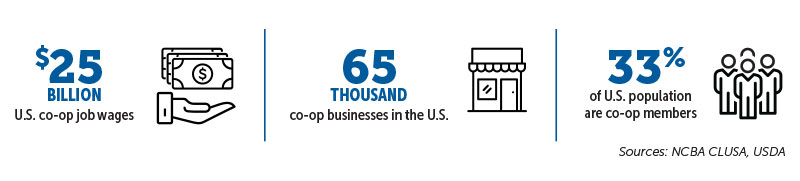
Did you know there are more sectors of co-ops? With 40,000 co-ops in the United States, cooperatives are all around us! They vary in size, industries and sectors; from your local grocery market or ACE Hardware store, to larger organizations such as Land O’Lakes.
October is Co-op Month: as a member, you hold the power.
Some of the various sectors include: utilities (like electric, telecommunications and water cooperatives); agriculture; education; credit union and financial services; food and grocery; healthcare; housing; and mutual insurance.
So, what is a co-op anyway? A cooperative is defined by the International Cooperative Alliance as “an autonomous association of persons united voluntarily to meet their common economic, social and cultural needs and aspirations through a jointly-owned and democratically controlled enterprise.” In layman’s terms, that means a fantastic business model created by people, for people, for a common cause.
Each cooperative business is run based on the values of the Seven Cooperative Principles. The two I will highlight are the First Cooperative Principle, “Democratic Member Control,” and the Sixth Cooperative Principle, “Cooperation Among Cooperatives.”
“Democratic Member Control” means you, as a member of an electric cooperative, have the power. You have a vote — YOU, the people who use the service of the cooperative, have a voice.
“Cooperation Among Cooperatives” is the principle I personally love the most. This principle is what makes cooperatives stand out from large, competitive corporations. Co-ops work together, across sectors and across industries, but also within the same industry and within the same sector. There is no cooperative competition stance as you might see elsewhere. Co-ops are the opposite of competitive.
Think about what happens following a bad storm. Different electric cooperatives join together from all over to help community members in their time of need.
Telephone and electric cooperatives are working together to determine the need for broadband in rural areas. Thanks to their cooperative work, co-ops are able to deliver more broadband in many rural areas.
Financial cooperatives also come to the rescue during times of need, such as the pandemic, with creative payment plans to continue helping its members. They also finance capital structures of individual cooperatives, in turn, serving more people.
These heroic efforts could not be done alone. The cooperation among cooperatives is endless, and the proof is in the pudding. We are stronger together. I bet you will find that you have cooperatives all around you. I challenge you to stay engaged with your electric cooperative, and seek out other co-ops to join in your community. Continue to use your power to make a difference in our world.
About the Author
Share Your Thoughts
Have a question about this story or just want to share what you thought? We’d love to hear from you!
Cooperatives give back

Seven Cooperative Principles


Randolph EMC Meets Member Needs Following Grid Attack
Co-op restores intermit power to members as Duke Energy repairs substations