



Dear Member,
This month, I’d like to dive deeper into one of our seven cooperative principles, Member Economic Participation. This principle reflects how members contribute equitably to, and democratically control, the capital of their cooperative.
Every product or service you buy from a business includes a margin, or profit, to ensure continued service and sustainability for the business. Your electric cooperative runs like a business but is actually a nonprofit. What sets the cooperative model apart from for-profit corporations is that the co-op returns those margins to our members in the form of capital credits.
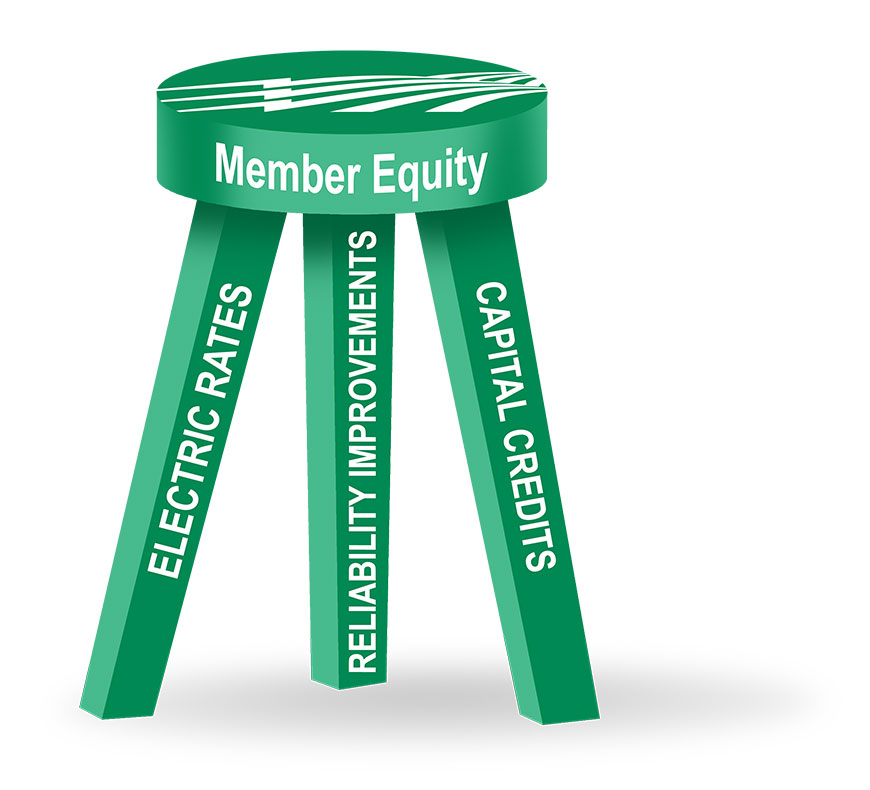
Think of this balance in terms of a three-legged stool. The legs are 1) electric rates, 2) reliability improvements and 3) capital credits.
To operate responsibly, your co-op must maintain a balance of offering affordable rates, investing in electric distribution and transmission reliability projects and returning capital credits.
Think of this balance in terms of a three-legged stool. The legs are 1) electric rates, 2) reliability improvements and 3) capital credits.
Any change in one of the legs has an impact on the other two. While the cooperative staff has done an outstanding job of controlling costs and maintaining a high level of reliability, wholesale power cost increases continue to outpace our retail rate increases.
While we review our wholesale power costs on a monthly basis, these costs can fluctuate modestly or significantly from month to month. We try our best not to make any sudden changes that would impact your electric bill. Instead, we adopt small, gradual changes to provide a smooth transition. We do this by implementing a charge through the WPCA (Wholesale Power Cost Adjustment), a line item on your bill.
Before May 2024, the WPCA has either been zero or a credit all the way back to 2013. As the industry experiences rising cost pressures, REMC reviews the WPCA and acts with good stewardship. This year in 2024, the board of directors did not authorize a general refund of capital credits. This was a strategic decision to maintain a delicate balance of rates, reliability projects and capital credits as well as to delay the cost impact to the members.
As we continue to see cost pressures, we must gradually increase the WPCA. In May 2024 the WPCA was a $1.00 charge per 1,000 kWhs used. In August the WPCA was set to a $3.00 charge per 1,000 kWhs used. Our statewide organization has recently signaled that we should expect additional increases in wholesale power costs for the remainder of the year. With this in mind, we will continue to use the WPCA to maintain the delicate balance of competitive rates, reliability investments and capital credits.
At Randolph EMC, our mission is to provide you with exceptional service and reliable electricity to power your home, business and life—all at the lowest possible cost. We are dedicated to keeping rates affordable, operating efficiently, and planning for your energy needs well into the future.
Cooperatively yours,
Dennis Mabe, Chief Executive Officer
Dedicated to you
Learn more about Randolph EMC, including our Seven Cooperative Principles.
More stories like this

A Place to Make Memories: Asheboro’s Jellystone Park

Time-of-Use Rates: Use Energy When It Costs Less

Celebrating You This National Co-op Awareness Month

Every Shot Counts
Two local students represented REMC at this year’s Cooperative All-Stars Sports Camp.