


Explore the origins of the Alleghany County’s Blue Ridge Parkway and learn about the rich history and significance of this iconic route, nestled in the Appalachian Mountains.
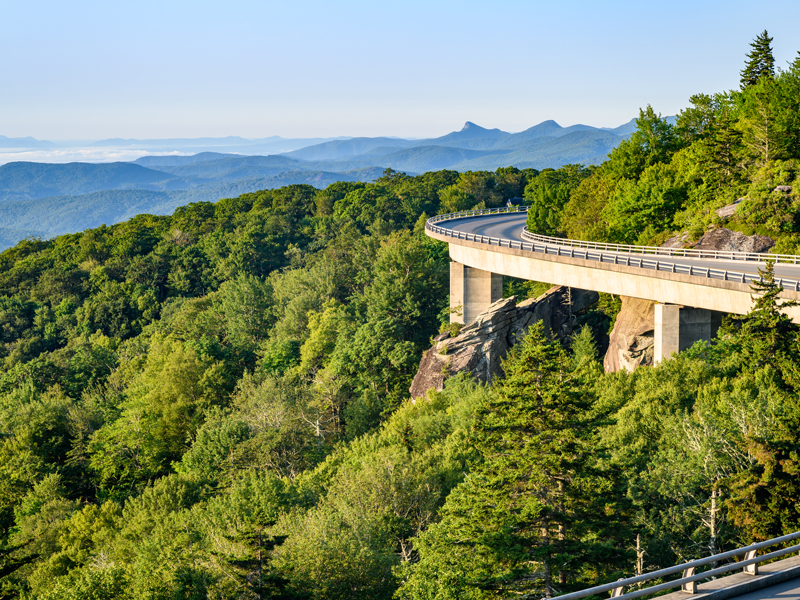
Linn Cove Viaduct on Blue Ridge Parkway
Although much of the beloved parkway was damaged by the high winds and flooding brought by Tropical Storm Helene last September, significant restoration progress is being made. News from communities along the parkway is positive, and since late 2024, many of the towns have been encouraging people to visit as access has opened up.
North Carolina officials in the 17 counties that the Blue Ridge Parkway traverses in the state have been keeping up with status of businesses and tourism destinations along the parkway.
“Asheville, Bryson City, Boone and most other destinations across the North Carolina mountains are eager to welcome visitors,” said Wit Tuttell, Visit NC’s executive director. (Select places currently open for visitors Come for a Visit, Stay for a while)
Officials in Boone in the High Country concur.
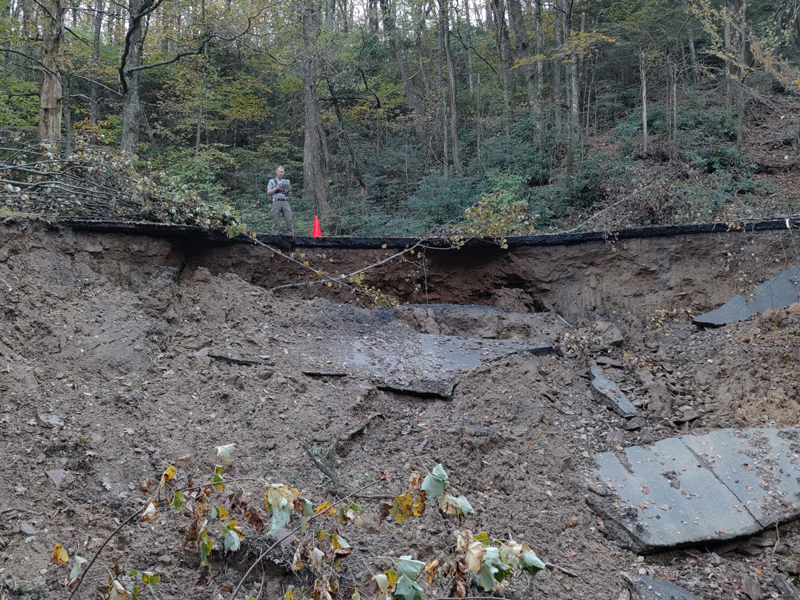
Washout under the Blue Ridge Parkway at milepost 345-10. Photo courtesy of the National Park Service.
“Our ski season was good this winter, and we’re working hard to get the word out that we’re open for business,” says Wright Tilley, executive director of Explore Boone. “Some sections of the parkway are still closed because of the damage [as of mid-February] and some winter weather closures, but we’re all looking forward to spring as more access is opened.”
Birth of an Icon
The 469-mile Blue Ridge Parkway, an iconic unit of the National Park Service, began in the early 1930s as part of President Franklin D. Roosevelt’s “New Deal” public works initiative to help put Americans to work during the Depression. Its purpose was to connect Virginia’s Shenandoah National Park to the Great Smoky Mountains National Park via a scenic highway through the Blue Ridge Mountains.
The parkway was designed to create parks and recreational areas that showcased the natural beauty and diversity of the Blue Ridge Mountains. Stanley Abbott, chief architect for the project, had a vision: “… to fit the parkway into the mountains as if nature had put it there.”
As a national treasure, the parkway captures the stories of our Appalachian history and heritage”
In September 1935, ground was broken near Cumberland Knob, North Carolina, creating road construction, recreation areas and landscaping. With nearly 170 miles completed, construction was interrupted during World War II. From 1946 through 1966, the majority of the parkway was completed; all but 7.7 miles were finished.
In 1983, work commenced on the final 7.7 miles, including the 1,243-foot Linn Cove Viaduct. It would take four years and 153 pre-cast concrete segments to complete the route along Grandfather Mountain that opened in 1987.
Restoring former glory
The National Park Service continues work repairing and restoring the Blue Ridge Parkway, and by mid-February, more than 310 miles of the 469-mile parkway have reopened. Approximately 217 miles in Virginia are open, but additional repair and clean up work continues in North Carolina.


Plan Your Drive
Visit National Park Service for up-to-date alerts, closures and parkway conditions on an interactive map.
“More places along the parkway are being opened to visitors,” says Angie Chandler, executive director of the Blue Ridge National Heritage Area. “Millions of people experience the Blue Ridge Parkway each year. It is not just because it’s a breath-taking drive that links the region to our people, heritage and culture.”
“As a national treasure, the parkway captures the stories of our Appalachian history and heritage,” she says. “Gateway communities and surrounding areas are rich with Cherokee culture, craft artisans, traditional music, farming and foodways, as well as many recreation opportunities such as hiking, biking, fishing and whitewater rafting. All of this is set amidst a beautiful mountain landscape.”
As spring and summer approach, more sections of the Blue Ridge Parkway will be open. The NPS website provides current information and updates about progress of ongoing repairs and restoration, including anticipated project completion dates (see “Plan your drive”).
“We’re encouraging people to check with tourism offices and other local experts who can provide accurate information about the current conditions in any given place,” Wit says. “Our website — VisitNC.com — is a good place to start. There’s a Western North Carolina Travel Update with information and an interactive map that helps people connect with destinations that have recovered and those that need more time.”
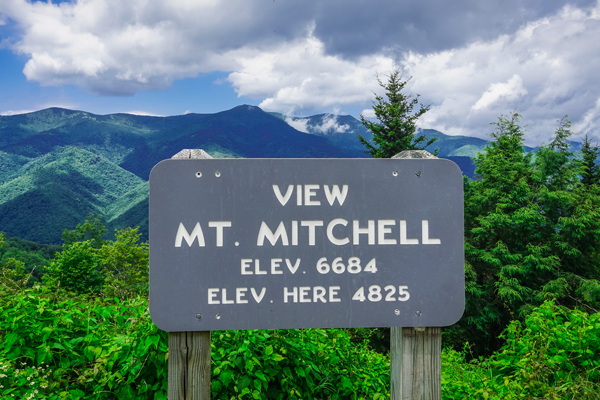
National Park Service
Epic sights answer key:
Highest peak: Mountain Mitchell, mileposts 344 and 376.6
Deepest gorge: Linville Gorge, milepost 316
Highest waterfall: Whitewater Falls, Jackson County
About the Author
Share Your Thoughts
Have a question about this story or just want to share what you thought? We’d love to hear from you!
Explore WNC

Mountain Town Detour
Blue Ridge Parkway construction is rerouting drivers through West Jefferson and Sparta