


“You don’t have to invite the entire wild kingdom into your yard,” says David Mizejewski, spokesperson with the National Wildlife Foundation. “We do, however, need to understand what brings them to our doors. Nature-based gardening practices are, of course, the main attraction, but when uninvited wildlife guests show up, it can be disconcerting.”
Creating a garden featuring an array of different plants that support a diversity of wildlife species helps restore that balance.
Often these critters are members of the local wildlife community who are drawn to a yard by a bowl of cat food left on the doorstep, or an open compost bin. They also may be homeless because of habitat loss and are looking for food and shelter in wildlife-friendly landscapes or landscapes loaded with yummy fruits, vegetables and foliage.
While they can pose a threat to humans, pets and property, most are more nuisances than dangers and can be dealt with in a kinder, friendlier manner. In fact, David says, the best defense is to create a natural balance in the landscape that accommodates all the critters in the neighborhood.
Gardening for wildlife requires a change in traditional attitudes toward “pests.”
“Most of the time in home landscapes, the only time you have real problems is when you have created such an unnatural scenario that things get out of balance, without natural checks and balances,” David says.
Creating a garden featuring an array of different plants that support a diversity of wildlife species helps restore that balance. Many native plants are either resistant to or repugnant to wildlife feeding, for example.
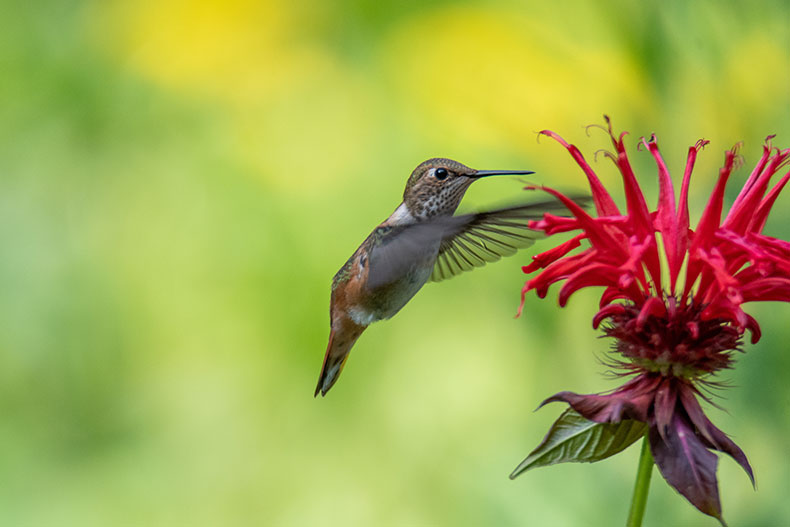
Bee balm attracts hummingbirds and butterflies July through September.
“Conventional gardening would say, if you see an insect eating your plant, you should run out and get some insecticide and spray it,” David says. “But if you have a little more information, you may recognize that the insect is a native caterpillar or a moth that is a really important pollinator — which is also a food source for birds trying to feed their babies — and the native plant it’s eating is adapted to be eaten by that caterpillar so it will not be damaged … why would you want to kill it?”
Compromise can also help, such as designing gardens using natural, flowing lines so that damage from wildlife feeding on plants is not as noticeable.
If the problem becomes too onerous for accommodation or compromise, though, the first line of defense is to use nonlethal and nonpoisonous controls, such as barriers, motion-activated sprinklers and unappealing scents and flavors sprayed on or around plants and areas of the yard. If that doesn’t work, turn to professional, humane wildlife control experts or wildlife conservation groups for help.
About the Author
Share Your Thoughts
Have a question about this story or just want to share what you thought? We’d love to hear from you!
More tips for a healthy garden


