


Every so often, the U.S. Congress approves a new round of energy efficiency standards for various appliances and equipment — refrigerators, air conditioners, clothes washers and the like. These standards, which began in 1975 and have been revised over the years, will have saved consumers an estimated $900 billion on their utility bills by 2020, according to the U.S. Department of Energy.
For example, a refrigerator purchased today uses one-third of the energy a 1973 model did — but with 20 percent more storage. Since 1990, new clothes washers use 70 percent less energy and dishwashers 40 percent less.
From microwaves to lightbulbs to commercial walk-in freezers, these standards have benefited family budgets — and the environment. Since 1987, 1.9 billion tons of carbon dioxide emissions have been avoided. That’s the same as taking 373 million cars off the road for one year.
In fact, despite an increase in U.S. population from about 233 million in 1983 to nearly 316 million today, larger homes, rampant personal computer and large-screen TV use, and more electronic devices vying for wall outlets, per-home energy consumption has steadily declined in the past 30 years, thanks to advances in energy efficiency for space heating, air conditioning, and major appliances, according to the U.S. Energy Information Administration.
As American homes add more and more electronic gadgets — about 25 on average, according to the Consumer Electronics Association — every little bit helps when it comes to saving energy.
Visit TogetherWeSave.com to learn more about saving energy and money.
Every so often, the U.S. Congress approves a new round of energy efficiency standards for various appliances and equipment — refrigerators, air conditioners, clothes washers and the like. These standards, which began in 1975 and have been revised over the years, will have saved consumers an estimated $900 billion on their utility bills by 2020, according to the U.S. Department of Energy.
For example, a refrigerator purchased today uses one-third of the energy a 1973 model did — but with 20 percent more storage. Since 1990, new clothes washers use 70 percent less energy and dishwashers 40 percent less.
From microwaves to lightbulbs to commercial walk-in freezers, these standards have benefited family budgets — and the environment. Since 1987, 1.9 billion tons of carbon dioxide emissions have been avoided. That’s the same as taking 373 million cars off the road for one year.
In fact, despite an increase in U.S. population from about 233 million in 1983 to nearly 316 million today, larger homes, rampant personal computer and large-screen TV use, and more electronic devices vying for wall outlets, per-home energy consumption has steadily declined in the past 30 years, thanks to advances in energy efficiency for space heating, air conditioning, and major appliances, according to the U.S. Energy Information Administration.
As American homes add more and more electronic gadgets — about 25 on average, according to the Consumer Electronics Association — every little bit helps when it comes to saving energy.
Visit TogetherWeSave.com to learn more about saving energy and money.
The ENERGY STAR Difference: Televisions
TV sales and sizes have increased dramatically in the U.S. over the past 20 years — an estimated 40 million sets, with an average screen size of 50 inches, left store shelves in 2012. Under the ENERGY STAR energy efficiency rating program for consumer products, TV electricity use averages 36 billion kWh per year less than if it didn’t exist.
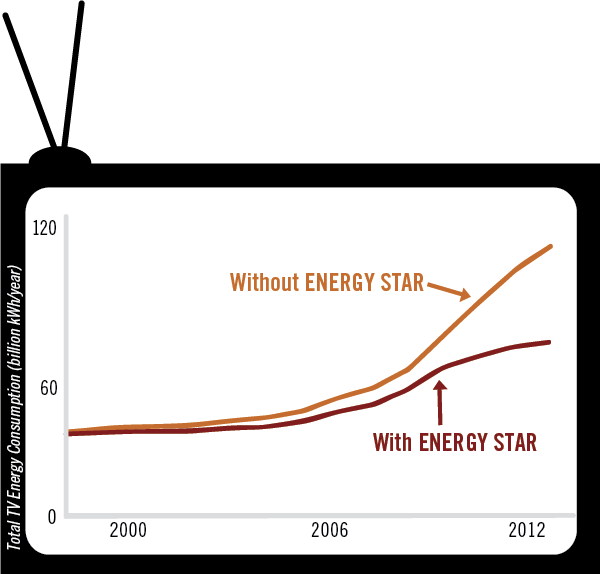
Source: U.S. Environmental Protection Agency, 2012
Share Your Thoughts
Have a question about this story or just want to share what you thought? We’d love to hear from you!
Related Stories
View All
Supporting Music on the Global Stage
Mojotone earned Exporter of the Year honors for its global business success

NC Electric Co-ops Advocate for Rural Communities at Rally in Raleigh
North Carolina electric co-ops bring the voices of rural communities to lawmakers in Raleigh

Technology Leader Named COO of NCEMC
Chris VanLokeren to help lead NCEMC through a changing energy landscape

NC Electric Cooperative’s CEO Joe Brannan Retires
Brannan reflects on 20 years of service