


“I am not overly fancy,” Schneider reflects. “I like to work with my hands, the hammer and an anvil.” His tools are mostly built in-house. He has a monkey wrench with a welded rebar to help him twist the spike-knife handle, a furnace made out of a fifty-gallon tank, and numerous other medieval looking tools hanging under his lean-to roof. “It is more challenging to build the tool, but then you have the right tool. The right tool makes every job easier.”
After the anvil work is finished, the knife has taken shape. The backyard blacksmith takes his knife‑in‑the‑making into his shed where a wood table is mounted by three bench grinders and a vice. Sparks shower the floor and the metal screeches as it is slowly, meticulously fashioned. Soon the blade is sharpened and the black, unburnt carbon is removed.
“Each spike is different, and so each knife will be different. I do not want to force my will upon the blade,” Schneider says in explaining how every knife looks unique. “Just like these chickens, it just does as it pleases.”
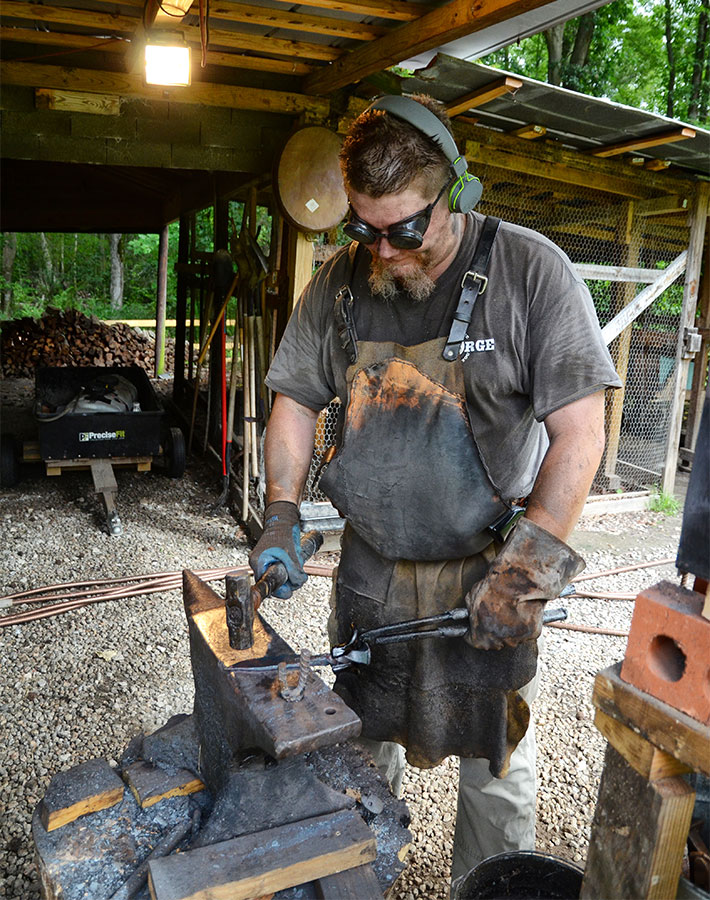
From his backyard forge with his Civil War-era anvil, Schneider takes his finished blades inside to cut, dye and bind the leather sheath. Originality is first priority.
“I am the only one I know of who makes this leather handle,” Schneider notes as he gently pulls a knife out. He closely guards the secret of his leather handles. Demonstrating with his burly thumb, he shows that the leather is bound so cunningly to the metal tang that even with heavy scratches and wear-and-tear, the leather does not rub loose or fray. Next, Schneider takes the handle and strikes the hard corner of his work bench. “A plastic handle would shatter, but leather can be buffed and shines even better after rough handling,” he says, sliding the knife back into its matching leather sheath.
Schneider’s flair for the exotic never lacks functionality. He sports a custom-made visor with rattlesnake leather, a cobra head and a deer antler; the last decoration serves to hold his sunglasses while he is indoors. He points to one knife’s black, bumpy handle, “this is stingray leather.” The material, which he imports from Southeast Asia, is surprisingly soft, comfortable and beautiful combined with the matching stingray leather sheath.
When not at the forge, Schneider stays busy demonstrating and promoting his trade at artisanal showcases across the state (he maintains a list of upcoming shows at spike-knife.com).
“I want to do things no one has attempted before,” he says in his workshop. “Rather than taking the easy way, I want to see skills developed locally. Something people will appreciate pursuing even after their work day. Something to take pride in.”
About the Author
Share Your Thoughts
Have a question about this story or just want to share what you thought? We’d love to hear from you!
Meet more Carolina People


Reenactors Go All-in to Bring the Past to Life
Locals are drawn to the hobby through a passion for history

Unlikely Cheesemakers
A Rowan County water buffalo herd yields surprisingly tasty cheese