


Each day, you’ll add more fertilizer, water or both, according to specific amounts, usually either ½ cup or ¼ cup per bale per day, followed by a soaking with water.
“It takes about two weeks to condition a bale,” Karsten says. “You’ll start seeing results of decomposition and the heat it generates by the end of the first week. A lot of biology happens in those bales.”
Bales are conditioned in much the same way compost is produced. Bacteria feed on the nitrogen that’s produced during decomposition, breaking down the straw and creating a nutrient-filled growing medium.
Planting your garden
Once the bale is property conditioned, you can plant seeds or seedlings directly. Karsten recommends using seedlings for novice gardeners and those who want a quicker start.
“Be careful with planting seedlings after the 12th day,” he says. “Stick a meat thermometer into the bale, and as long as the internal temperature is less than 105 degrees, it’s safe to plant seedlings. You can add water to reduce the temperature.”
Use a trowel to dig a hole in the top of each bale that’s a little bigger than the root ball, removing any netting or peat pots, then place the seedling into the hole, following the suggested distance between plants on the label.
You can add some sterilized potting mix to fill in the gaps; it should be weed- and disease-free. Be sure to monitor the bales daily to maintain consistent moisture. If they feel dry several inches into the bale, water them. Running drip irrigation can help with watering consistently.
Continue to fertilize the bales as you would your in-ground vegetable garden.
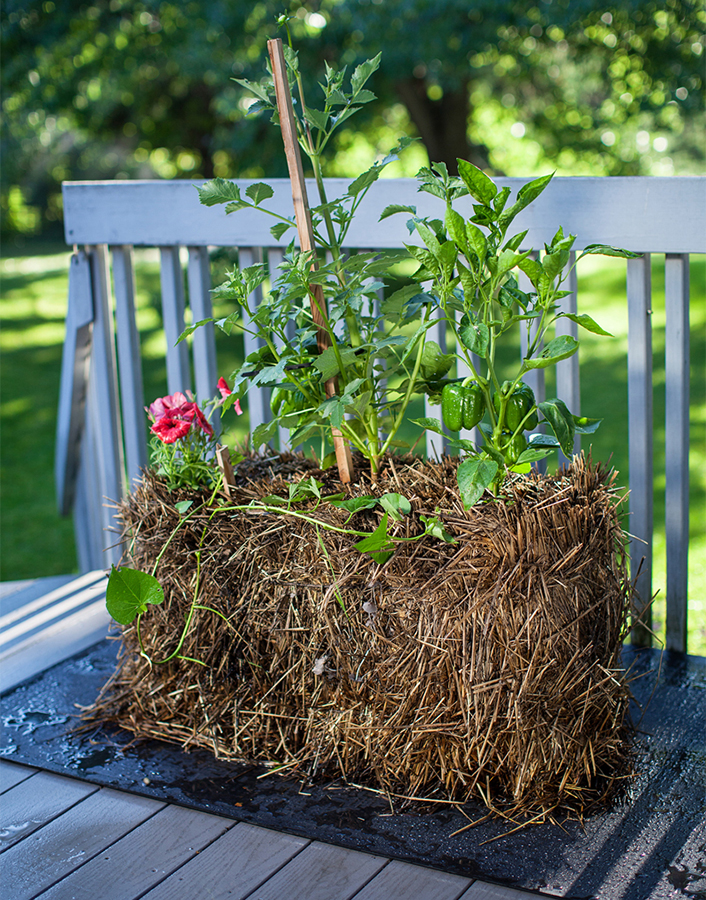
Straw bale gardening makes the harvest more convenient. “It’s like using raised beds,” Karsten says. “You don’t have to bend down to tend the plants or harvest your crops.”
Some of the most popular crops are tomatoes, squash and peppers, but by installing a trellis on each bale, green beans, cucumbers and other vining or trailing plants will grow very well. But straw bale gardening isn’t limited to vegetables.
“People grow fruit like strawberries, herbs or flowers in straw bales,” Karsten says. “Some people plant flowers or foliage annuals on the sides. Begonias and impatiens are good choices that will thrive alongside vegetables. And, it’s really easy to grow a kitchen herb garden in a straw bale.”
Admittedly, the straw bales will break down over the growing season.
“They’re not the prettiest thing in the world, but they create beautiful mulch that you can use in planter boxes, add to your compost pile or use in your garden next season,” he says. “Just take the strings out and push the straw into a pile. Then you can move it wherever you like.”
Sometimes bales can be reused for a second planting if they’ve remained intact. If you’ve used landscape fabric beneath them, they’re likely to hold up for a second season. But Karsten suggests starting each season with fresh bales to reduce the risk of disease.
“If you follow the basic directions, you’ll have about a 70 percent success rate,” he says. “And at least one-fourth of that will be bigger and better than your yield from traditional gardening.”
Visit strawbalegardening.com for more information about straw bale gardening techniques.
About the Author
Share Your Thoughts
Have a question about this story or just want to share what you thought? We’d love to hear from you!

