


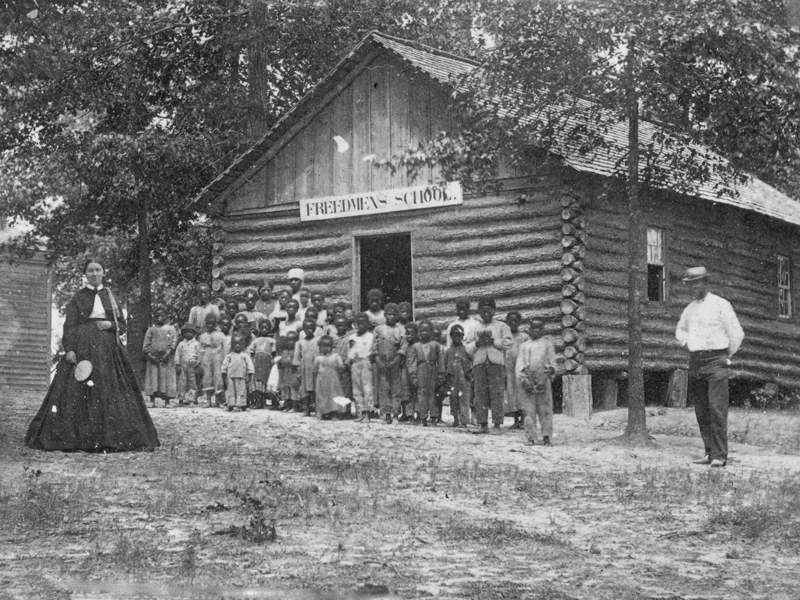
Early school in the colony would have been similar to this Freedmen's School in New Bern (c. 1868).
That all changed on February 7, 1862, when the Northern Army, commanded by General Ambrose Burnside, took control of Roanoke Island.
The federal government declared the slaves on the island emancipated. Initially, the freed slaves were considered contraband. As the war progressed, the word “contraband” was replaced with “freedmen” by the military. The word quickly spread throughout the state that Roanoke Island was a safe haven.
Building community
Hundreds of slaves arrived from the mainland seeking freedom. The federal government seized local land on the north side of the island to make room for the increased population, which eventually reached almost 4,000 men, women and children. The able-bodied men were recruited to join the Army. Some freedmen acted as spies, scouts and guides for the Union.
In the beginning, they took shelter wherever they could find it — abandoned Confederate barracks and other unused shacks. It was quickly apparent these people needed housing, food and medical care.
Major General John G. Foster called on the Army Chaplain, Rev. Horace James, to oversee settling the freed slaves on the unoccupied lands. Rev. James distributed tools and equipment and provided training for “living as a free and independent community.” Each family was allotted one acre of land where they could build a cabin and had room for a garden. Rev. James reported the freed slaves worked night and day, singing as they worked.
By 1864 over 550 homes had been built for the 3,901 freed slaves. Schools, churches, and sawmills were constructed, and a community was born. One of the churches, Haven Creek Church, still stands today as Haven Creek Missionary Baptist Church, located at 611 Sir Walter Raleigh Street in Manteo.
A former slave woman, Martha Culling, opened the community’s first school. It is not known where she came from or her life outside of teaching at the school she organized. In March 1864, Samual Nickerson opened another school. Martha assisted Samual at the Cypress Chapel School at one of the old Confederate barracks, which had room for more students. Later more teachers arrived. Children and adults learned to read and write, which they were not allowed to do while slaves.
After the war
Sadly, at the end of the war, the U.S. government ordered that all of the land that had been confiscated to build the colony be returned to the original owners. Food rations were reduced, workers were never paid the wages that were owed to them or given the rights they had been promised. The population was reduced by half, as many left the island to start new lives elsewhere. Only a few families stayed on Roanoke Island. By 1887 the colony was dissolved.
Descendants of the freedmen still live on Roanoke Island today. Much of what we know about the Freedmen’s Colony is attributed to their work in preserving that history.
Joan Collins, as a descendent of one of the colony families, explains what the work to preserve the history of the Freedmens’ Colony has meant to her.
“As a descendent of those who lived on the Freedmen’s Colony, I am pleased that this story is being told,” Joan says. “It is an important part of the history of Roanoke Island and the Outer Banks, which unfortunately often is overlooked despite the area’s historical significance. The ties this story has to the historic all-Black Pea Island Lifesaving Station is also a powerful symbol of what can be achieved through determination and perseverance.”
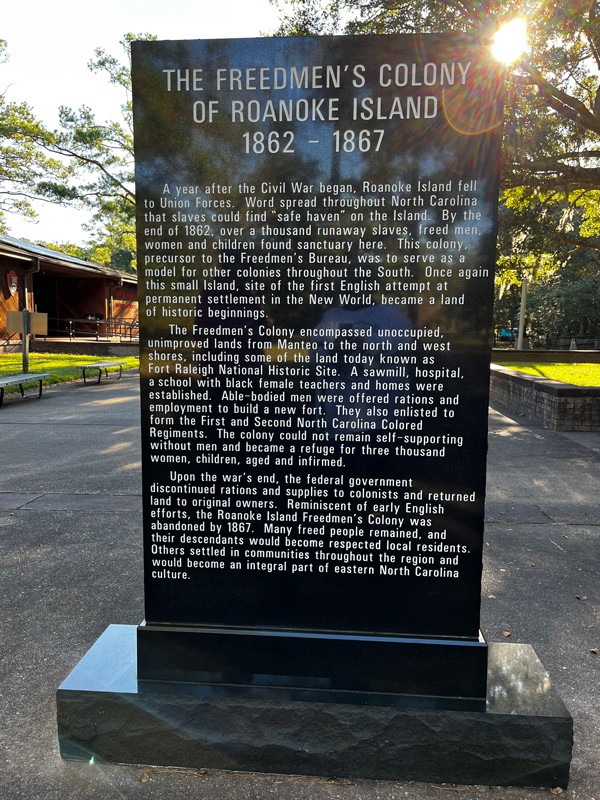
The Pea Island Cookhouse Museum in Manteo, open for special events and by appointment, houses a collection of information about the Freedmen’s Colony. Visitors to Fort Raleigh National Historic Site will find a monument that briefly tells the story of the origin of the colony, as well as the 2.5-mile Freedom Trail, which shares the story through interpretive signs and metal cutout silhouettes of dancing figures, signifying the joy of reaching freedom.
“Stories such as these stand as a testament to the power of hope and the relentless pursuit of freedom,” Joan says. “My connection to this history inspires me to honor those who sought freedom and to continue their fight for equality and justice.”
About the Author
Share Your Thoughts
Have a question about this story or just want to share what you thought? We’d love to hear from you!
Honoring Black history month


